






A 3D-printer for soap
As additive manufacturing evolves, the boundaries of innovation are increasingly defined by new materials rather than machine design. One early yet visionary milestone in this direction was Soap01™, the 3D printer invented by Emanuele Mulas (M.Sc.) and developed by Wittystore, which successfully demonstrated the extrusion of solid soap as a printable medium. More than a decade later, the same concept is resurfacing — reaffirming Wittystore’s position as an early pioneer in alternative and sustainable material technologies.
Behind the Innovation
Soap01 emerged as a desktop-scale 3D printer capable of accepting soap bars or soap-offcuts, melting them and then extruding or depositing layers of soap into custom forms. The underlying vision: convert “almost waste” soap remnants into branded, bespoke or unique soap shapes — for retail display, packaging or decorative use — while demonstrating that additive manufacturing can extend beyond plastics and metals to everyday consumables.
Why it mattered then
At its debut (2015), Soap01 made headlines for two reasons:
- Its novel feedstock (solid soap), and
- Its implication for reuse and customisation in the cosmetics, fragrance and pharma-retail sectors.
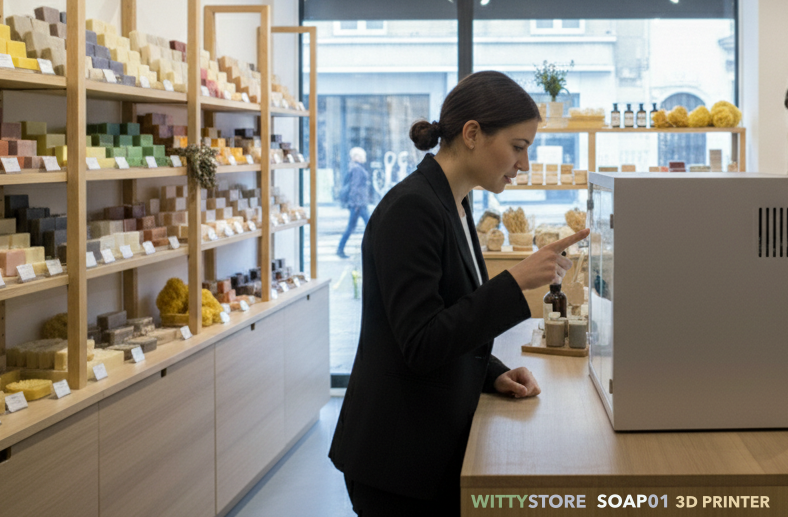
Press coverage from multiple countries underscored the idea that even something as familiar as a soap bar could be re-imagined through 3D printing. Partnerships between Wittystore and fragrance/pharma brands during 2015–2016 leveraged this novelty for in-store installations and limited-edition runs, thereby validating the business potential of custom-soap printing.
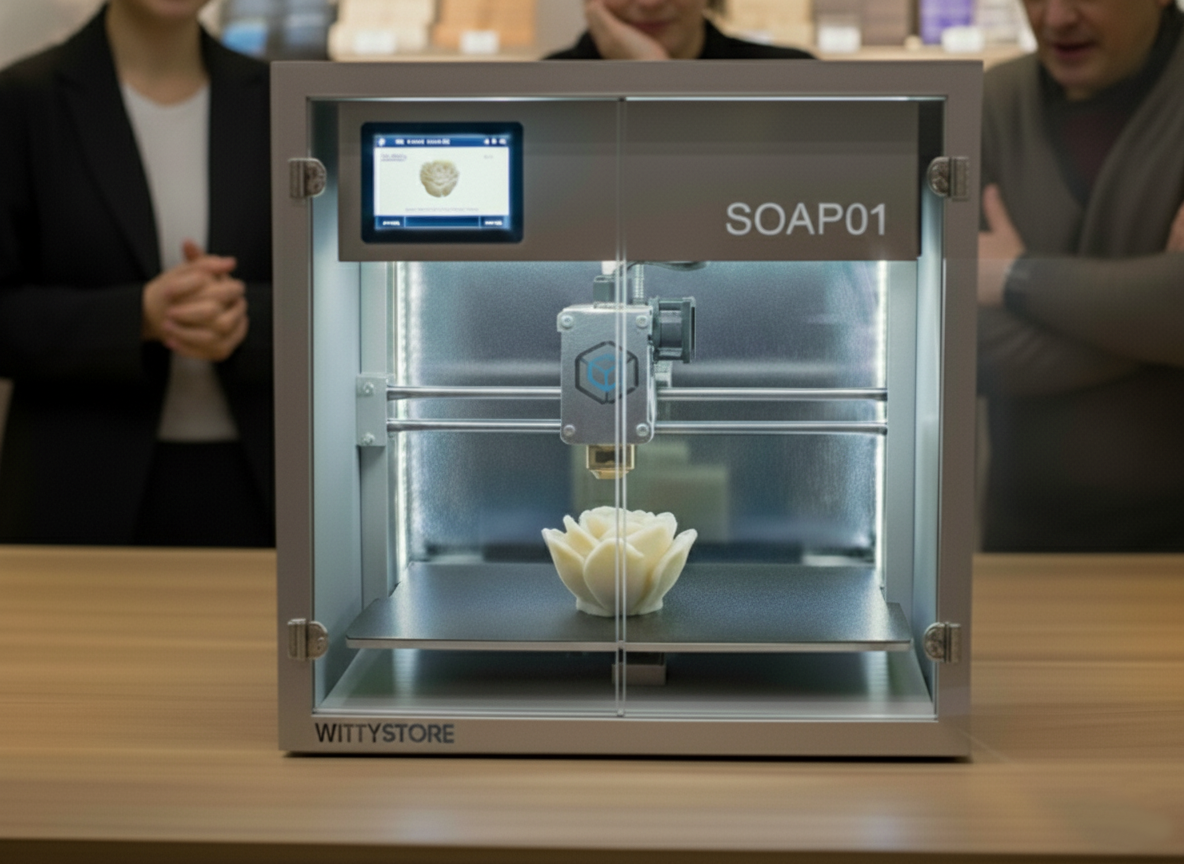
Renewed relevance today
Fast-forward to 2025: several companies have launched soap-printable filaments and consumer-scale materials that treat soap and soap-like compositions as 3D-printable feedstocks. This resurgence validates Wittystore’s early work. The conditions are now more favourable: broader awareness of sustainability, appetite for custom branded objects, and improved material systems. For Wittystore, this creates a strategic moment: the original Soap01 concept is not simply “old news” — it’s a credible precursor to what’s happening now.
What this means for brands, makers and designers
Sustainable impact: Re-using soap remnants aligns with circular economy goals. Soap01’s model of recycling soap into new forms speaks directly to zero-waste and up-cycling narratives.
Customization & brand engagement: Retail categories like fragrance, cosmetics and giftware are increasingly interested in on-demand, custom shaped consumables. The early pilots with Soap01 demonstrated this viability.
Material innovation: Additive printing of soap poses distinct challenges (melting behaviour, cooling, adhesion, extrusion) that differ from plastic filaments. Designers working with smell, texture and user-experience can differentiate by working across form and function.
Looking Ahead – From Soap to the Future of Smart Materials
When Soap01™ was conceived, 3D printing itself was still a young technology. Artificial Intelligence and advanced material science were only beginning to emerge as tools for creative manufacturing. Yet, Wittystore’s work with soap already hinted at a larger truth — that innovation starts where imagination meets experimentation.
Printing with soap was not just a curiosity; it was a proof of concept for material diversity, demonstrating that 3D printing could extend far beyond plastics and metals. Soap, with its unique combination of softness, thermal behavior, and surface chemistry, shares properties with many of the biomaterials, composites, and soft polymers now being explored for robotics, medicine, and sustainable design.
Today, with the integration of AI-assisted design and simulation, the potential of such materials is exponentially greater. AI can predict flow dynamics, optimize extrusion parameters, and even generate entirely new soap-like compounds with tailored properties — something unthinkable a decade ago. What began as an experiment in reusing everyday soap is now echoed in global efforts to print with adaptive, biodegradable, and intelligent materials.
At Wittystore, the original motto — “Conquering the Future!” — feels as relevant today as ever. Soap01™ was just the beginning: a tangible demonstration that foresight, creativity, and courage to experiment can shape the technologies of tomorrow. And as industries evolve toward smarter, more sustainable materials, Wittystore’s early vision continues to stand as a reminder — that even the simplest materials can spark revolutions.
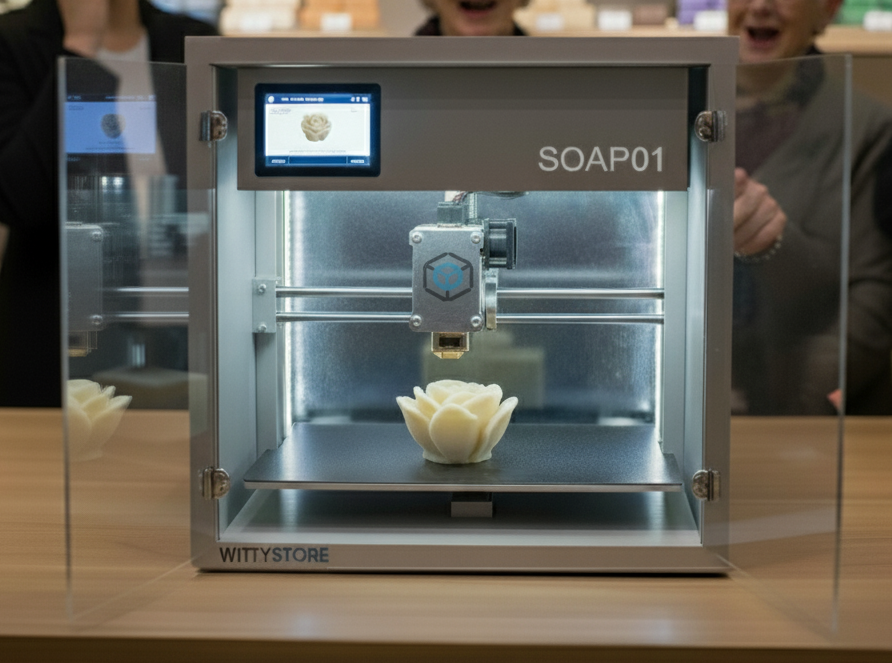
If you’re experimenting with recycled soap pellets or soap filament, the Soap Bar Generator Free 3D Printing App by Wittystore is the perfect companion. It lets you design custom soap bars right in your browser — adjust size, emboss text or logos, preview the 3D model, and export it instantly for printing. Pair it with Wittystore pellet extruders designed for soapy materials, and you can transform your recycled soap pellets into beautifully shaped, personalized bars ready for production or gifting.
Click here to try the 3D Printable Soap Bar Generator free online app

