




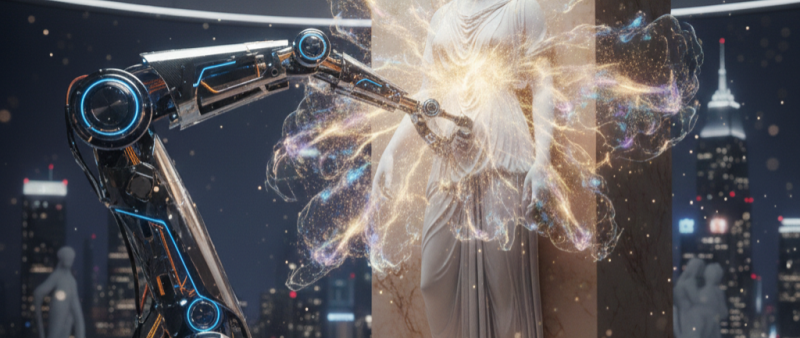


Beneath these apparently simple acts lies something invisible yet real: intention. It is not merely a thought or a desire, but the capacity to orient possibilities towards action, transforming what could happen into what actually does. To clarify this role, imagine a sculptor before a block of marble.
In a Newtonian view, the sculpture is already contained in the stone and the artist merely reveals it. The future is fixed, awaiting discovery. In a more quantum-inspired perspective, the marble contains several genuine possibilities, none defined in advance. The sculptor selects which form becomes real. Here intention is not passive execution: every gesture matters, error becomes informative, and correction enables learning.
Federico Faggin, inventor of the microprocessor and a pioneer in consciousness studies, argues that consciousness is a fundamental reality manifested by biological beings rather than produced by them.
Geoffrey Hinton, a key figure in modern artificial intelligence, suggests instead that sufficiently complex systems may develop forms of functional experience similar to ours, at least cognitively.
Both positions help clarify the gap between simulation and experience, while leaving open the deeper question of why intention exists at all.
Modern science has largely relied on determinism and chance. Events are either fully caused or random. In both cases, intention seems excluded: too structured to be chance, too subjective to count as a physical cause. Yet intention pervades human life. We easily distinguish accidents from deliberate acts, and this distinction reflects a real difference in how events come about.
Invoking intention does not require a strong metaphysical notion of free will. Even in a fully determined universe, some behaviours are goal-directed, sensitive to error and open to revision, while others are not. Intention is therefore a functional and phenomenological fact: a specific way certain systems interact with the world.
Quantum physics undermines the classical image of a fully defined reality. At its core, reality consists of structured possibilities rather than fixed outcomes. Intention does not violate physical laws; it operates by selecting and orienting possibilities within given constraints. Like a navigator using winds and currents, it works through existing conditions rather than overriding them.
Error plays a crucial role here. In a rigidly deterministic universe, error is meaningless; in a purely random one, it is equally so. Error becomes intelligible only where real aims exist but are not guaranteed.
For humans, error is perceived, interpreted and transformed into guidance for future action, as Seneca already observed in errare humanum est. Reducing intention to neural signals may describe its physiological correlates, but it does not exhaust its meaning. Mapping brain activity no more explains wanting than analysing sound waves explains music.
This is not naïve dualism, but recognition that different levels of description are not interchangeable. As artificial intelligence grows more sophisticated, this distinction becomes decisive. Machines can optimise goals and learn from failure, but this constitutes functional, not lived, experience.
The challenge is not machine intelligence itself, but whether systems could ever develop an internal point of view.
Reintroducing intention as a serious philosophical concept does not weaken scientific rigour; it acknowledges its limits. In a universe of structured possibilities, intention introduces direction without eliminating uncertainty. It may not be a fundamental force, but it is a fundamental feature of human existence.
Between necessity and contingency lies the space where human, and perhaps post-human, experience takes shape.
Author: Emanuele Mulas, MsSc., MiEI

