




3D Computer Graphics in the Real World
My Account Wish List (0) Shopping Cart Checkout
Wittystore
Login
E-Mail Address:
Password:
Forgotten Password
Sign Up Join Us
// `$_SERVER['REQUEST_URI']` to get the current URL and then check if it contains 'latest-blog' // If the user is using the blog the language menu above is not shown so that the blog is only in english
€
€ Euro £ Pound Sterling $ US Dollar
0
0
0 €0.00
Your shopping cart is empty!
Menu
  • Home
  • 3D Models Download
    • Art
    • DIY
    • Ecolife
    • Garden
    • Home
    • Learning
    • Music
    • Sport
    • Style
    • Board Games
    • Office
    • Toys
    • Characters
    • Collections
      • Baby shower
      • Christmas
      • Earrings
      • Halloween
      • Key-chains
      • Movember
      • Phrases
      • Picks
      • Vehicles
      • Vikings
  • Hardware
    • Consumables
      • Filaments
      • Materials
      • Accessories
      • Resins
      • Composite Powder
    • 3D Printers
      • By industry
      • By series
      • By application
      • By technology
      • By materials
    • 3D Pens
    • 3D Scanners
    • Laser Engravers & Cutters
  • Software
    • 3D Modelling Software
    • 3D Printing Software
    • AI Software
    • CNC Software
    • Metaverse
    • Video games
  • Learn
    • Video Courses
    • Books
  • Upload

    Share your digital creations!

    upload digital content

    UPLOAD

    Become a Wittyer

    Login/Sign up for a "Wittyer Profile" and upload your content with our easy-to-use tool.

    Choose your licence

    Choose the license that best represents your work between commercial or open source options. Check licences here

    Monetize

    For each download, you will receive up to 85% of the net selling price. Check our royalty options here

  • Customizer3D
  • Blogs
  • 3D Models Download
    • Art
    • DIY
    • Ecolife
    • Garden
    • Home
    • Learning
    • Music
    • Sport
    • Style
    • Board Games
    • Office
    • Toys
    • Characters
    • Collections
      • Baby shower
      • Christmas
      • Earrings
      • Halloween
      • Key-chains
      • Movember
      • Phrases
      • Picks
      • Vehicles
      • Vikings
  • Hardware
    • Consumables
      • Filaments
      • Materials
      • Accessories
      • Resins
      • Composite Powder
    • 3D Printers
      • By industry
      • By series
      • By application
      • By technology
      • By materials
    • 3D Pens
    • 3D Scanners
    • Laser Engravers & Cutters
  • Software
    • 3D Modelling Software
    • 3D Printing Software
    • AI Software
    • CNC Software
    • Metaverse
    • Video games
  • Learn
    • Video Courses
    • Books
  • Customizer3D
  • Blogs
Blog Category
  • Facts & News
  • Guides & Tutorials
    +-
    • Blender Tools and Commands
  • Tech Explained
  • Industry Insights
You may like

Categories
  • 3D Modelling
  • Desktop 3D Printers
  • holocube
  • 3D Models Download
    +-
    • Art
    • DIY
    • Ecolife
    • Garden
    • Home
    • Learning
    • Music
    • Sport
    • Style
    • Board Games
    • Office
    • Toys
    • Characters
    • Collections
      +-
      • Baby shower
      • Christmas
      • Earrings
      • Halloween
      • Key-chains
      • Movember
      • Phrases
      • Picks
      • Vehicles
      • Vikings
  • Hardware
    +-
    • Consumables
      +-
      • Filaments
      • Materials
      • Accessories
      • Resins
      • Composite Powder
    • 3D Printers
      +-
      • By industry
      • By series
      • By application
      • By technology
      • By materials
    • 3D Pens
    • 3D Scanners
    • Laser Engravers & Cutters
  • Software
    +-
    • 3D Modelling Software
    • 3D Printing Software
    • AI Software
    • CNC Software
    • Metaverse
    • Video games
  • Learn
    +-
    • Video Courses
    • Books
  • Projects
  • Solutions
    +-
    • Personal Solutions
      +-
      • Personal 3D Printers
      • Holographic Displays
      • Personal 3D Scanners
    • Professional Solutions
      +-
      • Professional 3D Printers
      • Hologram Showcases
    • Industrial Solutions
      +-
      • On Demand Parts
      • Production 3D Printers
    • Tools & Devices
AR fused filament fabrication Plant-based UV Resin 3d models female by industry drink car concept blender 2.8 getting started java script library
Home » Facts & News » Beyond the Cave of Bits: The Revolution of Analogue AI
14 Feb
Share This:
    Share on Facebook X Post to Tumblr Pin it Submit to Reddit Share on LinkedIn Save to Pinboard Send email

Beyond the Cave of Bits: The Revolution of Analogue AI

14 Feb 2026
Published In: Facts & News Hits: 5

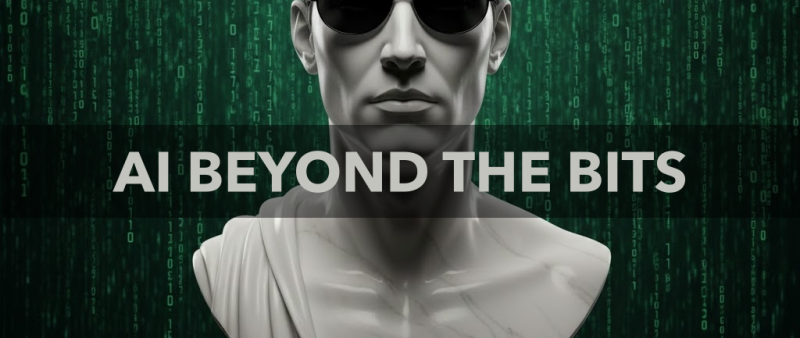
From The Matrix to Plato’s cave, discover how analogue computing could overcome the limits of digital machines, reduce energy consumption, and reshape the future of artificial intelligence.

In the famous 1999 film The Matrix, humanity has been subjugated by Artificial Intelligences and lives within an interactive neural simulation.

Yet the protagonist, Neo, much like in Plato’s Allegory of the Cave, is able to go beyond. He sees the computation, the interweaving of data, converted by machines into signals sent to our brains to keep us enslaved in a virtual reality known precisely as “the Matrix”.

Without venturing too far into science fiction, it is in fact mathematical structures known as matrices that enable computers to create three-dimensional images, animate characters in video games, and power Artificial Intelligence systems. Every digital action — even every word generated by a system such as ChatGPT — is the result of an enormous number of calculations carried out through these numerical tables.

The computers we use today are digital machines, meaning they operate by reading and manipulating just two states: 0 and 1, on and off. This approach, which made the information technology revolution possible, is now encountering increasingly evident limits. The great boom in AI is making us realise that, despite remarkable achievements, the computational capabilities of current machines are nearing their limits. On the one hand, there is the so-called Von Neumann bottleneck, where vast amounts of energy are wasted moving data between memory and processor. On the other, there is the crisis of Moore’s Law, which predicted the doubling of the fundamental components of chips every two years. Transistors are now so small that they are approaching atomic dimensions, making it ever more difficult to shrink them further without running into insurmountable physical constraints.

To overcome these obstacles, analogue computing is being rediscovered. Unlike digital computing, it does not rely on 0s and 1s, but on continuous signals, such as electrical current or the mechanical movement of gears. This is not an entirely new idea: one of the earliest examples of an analogue computer is the Antikythera Mechanism, a sophisticated Greek device over two thousand years old used to predict the movements of celestial bodies. The most intriguing aspect of analogue technology, particularly for Artificial Intelligence, is the possibility of directly exploiting the laws of physics to perform the matrix multiplications typical of neural networks. In this way, rather than coordinating thousands of tiny electronic switches, the result emerges naturally from the behaviour of materials, with a drastic reduction in energy consumption.

In recent years, several companies and research centres have brought this technology back to the forefront of innovation. The American company Mythic has developed chips that use flash memory, similar to that found in USB drives, to carry out AI calculations with very low energy consumption.

Researchers at Peking University have created chips based on RRAM technology that promise markedly higher speed and energy efficiency compared with traditional processors, including those produced by Nvidia.

In Germany, the company Anabrid markets a small analogue computer called The Analog Thing, designed to help students and researchers tackle complex problems using an approach different from that of conventional computers.

The impact of these advances could be enormous. An example of what computational power can already achieve is AlphaFold, the system developed by DeepMind that has determined the structure of around 200 million proteins — a result that would have required an extremely long time using traditional methods.

With the evolution of analogue chips, in the future we may have medical devices, sensors and intelligent instruments capable of operating for years on a small battery, processing data and learning directly on site, without the need to rely constantly on an internet connection.

If, in the film, the machines of the future are hungry for energy and dominate humankind, in reality they may consume little and amplify our capabilities.

The real risk, then, is not that machines will think too much, but that humanity will cease to do so. Plato had already intuited this, urging us not to prefer the comfort of shadows on the wall to the light outside the cave.

Author: Emanuele Mulas M.Sc. MIEI
Publisher: Wittystore
License: Attribution-NonCommercial-NoDerivatives 4.0 International (CC BY-NC-ND)
https://creativecommons.org/licenses/by-nc-nd/4.0/

Tags: artificial intelligence analogue computing digital computing limits energy efficient AI neural networks hardware von Neumann bottleneck Moore’s Law AI chips future of computing philosophy of technology
Same In Category
  • 3D Printing Sustainable - National Construction Summit 2015
  • Skryft: The sand writer, a mobile 3d printer by Gijs Van Bon
  • 3D Printing Food in Ireland with the ChefJet Pro
  • 3D Printing Concrete Houses in Eindhoven
  • XYZprinting Releases Nobel Superfine a 3D Printer for Jewelers and Dentists
  • Who invented solar panels (photo-voltaic modules)?
  • The smarthphone 3D printer ONO prints 5.2 cm in just 2.5 hours
  • The inventor of 3D Printing
  • The first 3D printed object in space
  • Smartphone 3D Printers OLO and ONO, what's the first?
Related Blogs By Tags
  • Will Digital Minds Replace Us? Geoffrey Hinton Thinks So
  • The thinking machine: I and AI
  • The Paradox of AI: From the Automation of Humans to the Anthropomorphization of Machines
  • The impact of AI on the development of children
  • Can machines be truly random? AI vs the chaos of nature
  • Beyond the Cave of Bits: The Revolution of Analogue AI
  • Artificial Intelligence: An Opportunity to Understand
  • Artificial Cinema
Sign in with Sign inSign inSign inSign in

Find us also on:

About us

Wittystore is a company focused on products that are ingeniously clever in conception, execution and expression.

GET IN TOUCH:

 General Enquiries

 Business Enquiries

 Get Support

Information
  • About Us
  • Create Account
  • Privacy Policy
  • Terms & Conditions
  • Advertisement Rates
  • Licences for Digital content
  • Contact Us
Extras
  • Brands
  • Gift Vouchers
  • Affiliates
  • Specials
  • Site Map
My Account
  • My Account
  • Order History
  • Returns
  • Wish List
  • Newsletter
All rights reserved Wittystore © 2014-2026, Company Reg.No. 544064 Ireland, VAT Registered
secure website
