




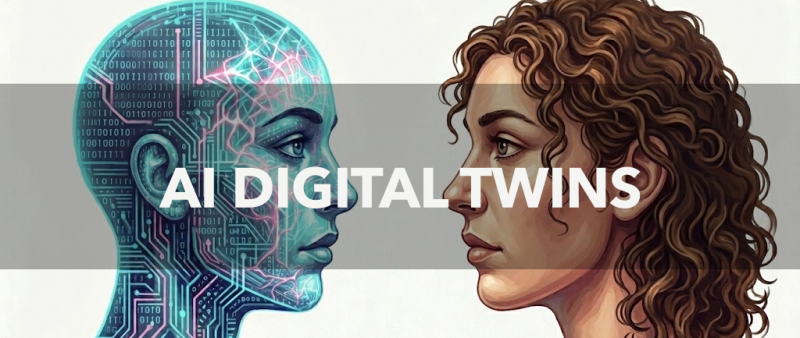


In practical terms, this would involve the creation of a virtual twin (an AI Digital Twin) capable of reproducing his face and expressions, generating content continuously and in multiple languages. Such a solution would make it possible to produce new content without requiring the creator’s constant physical presence.
Although Khaby will retain an operational role and a controlling stake, his “persona” has effectively become a scalable technological asset, no longer constrained by biological or personal limitations.
This development raises several questions. Who is responsible for content generated by a digital model? How central does the individual remain in relation to their representation? And how might the relationship between authenticity and performance evolve?
The idea of “replicating” an artist is not new within the cultural imagination. The film The Congress 1, for instance, tells the story of an actress who agrees to fully digitise her image in order to be replaced by an avatar.
While in cinema such a choice is often portrayed in dystopian terms, in today’s reality it can be interpreted in different ways: both as a technological opportunity and as a potential risk of replacement.
Indeed, while Khaby Lame appears willing to embrace the frontier of the “digital twin”, Hollywood is experiencing something of a revolt against this very scenario.
At the beginning of 2026, more than 800 professionals from the creative industries launched a major anti-AI campaign, accusing Big Tech companies of “theft” for training models on their work without consent.
Several actors, including Robert Downey Jr. and Nicolas Cage, have publicly declared that they will take legal action against anyone who attempts to replicate their image, both during their lifetime and after their death.
From a philosophical perspective, the issue touches on the problem of personal identity. According to the English philosopher John Locke 2, identity coincides with the continuity of consciousness; from this standpoint, a digital replica would not be the person themselves, but merely a representation.
Other philosophers, such as Derek Parfit 3, have argued that identity is more closely tied to psychological and narrative continuity. In this view, a highly sophisticated simulation might appear as a functional extension of the individual, while still remaining distinct from them.
Beyond philosophical theory, the central issue concerns the evolution of the image economy. Content creators and influencers no longer sell only their time or attention; they may increasingly monetise the reproducibility of their own “existence”.
For this reason, from a legal perspective, despite strong opposition from those who advocate a completely free and unregulated market, some institutions have already begun to intervene.
In May 2024 the European Union approved the first comprehensive regulatory framework dedicated to artificial intelligence, known as the Artificial Intelligence Act 4. Fully operational from 2026, the regulation introduces transparency obligations for synthetic content, requiring that deepfakes be clearly identifiable as such.
This means that Khaby’s “twin” would be required to disclose every appearance as artificially generated.
In addition, under the General Data Protection Regulation (GDPR), biometric data are classified as particularly sensitive information and are therefore subject to enhanced safeguards.
While the European approach is characterised by a precautionary logic—aimed at regulating the field before systemic risks become irreversible—the model adopted in the United States has historically been more reactive, often intervening only after harm has already occurred.
Nevertheless, awareness that digital identity is an asset worthy of protection is not limited to Europe. Countries such as China and Canada have recently introduced strict protocols for labelling digital clones, signalling a growing global convergence around the need for transparency.
The aim, ultimately, is not to halt progress, but to strike a balance between innovation and fundamental rights—ensuring that personal identity does not become an object of uncontrolled exploitation.
Article Author: Emanuele Mulas (MSc MIEI)
Notes
- The Congress – A film by Ari Folman exploring the digitalisation of identity and the replacement of actors with digital avatars.
- John Locke (1632–1704) – English philosopher known for the theory that personal identity is grounded in the continuity of consciousness.
- Derek Parfit (1942–2017) – British philosopher who developed a conception of identity based on psychological and narrative continuity rather than physical substance.
- Artificial Intelligence Act – The first comprehensive European regulation on artificial intelligence, designed to ensure transparency, safety and the protection of personal data, including biometric information.
Article illustration: “La Gemella Digitale” © Emanuele Mulas, created through a combination of manual and digital techniques, with AI used as a creative tool.

