






Companies such as Meta, X, Microsoft, ByteDance, Apple and Alphabet operate infrastructures used every day by hundreds of millions of European citizens to access information, communicate and work. Under European legislation, several of these companies fall within the category of Very Large Online Platforms established by the Digital Services Act[4], which entered into force in 2022 alongside the Digital Markets Act.[5] The two regulations seek to strengthen the transparency of algorithmic systems, curb anti-competitive practices and enhance user protection. In recent years, the concept of “digital sovereignty”[6] has gained prominence in European political debate. It refers to the European Union’s ability to control strategic infrastructure, data and technologies. Institutional reports and independent analyses highlight the fact that Europe is one of the world’s largest digital markets, yet it does not host global platforms on a scale comparable to those based in the United States or China in areas such as social networks, search engines or public cloud services.
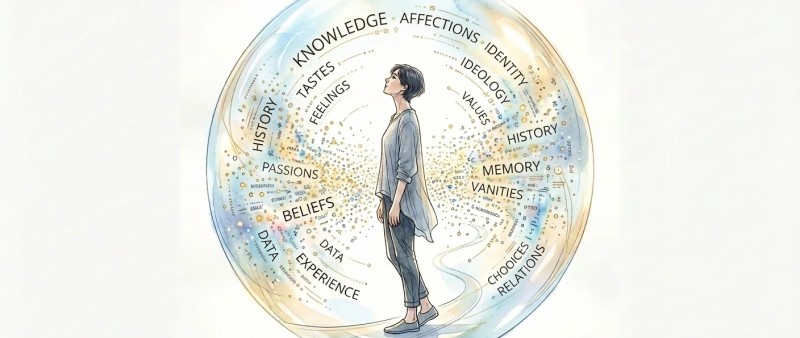
This asymmetry fuels debate about technological dependence and the industrial policies needed to reduce it. At the heart of the discussion is also the role of algorithms in selecting and distributing content. Numerous empirical studies have shown that recommendation systems influence exposure to information and can contribute to the formation of homogeneous communication environments, often referred to as “echo chambers”.[7] In the field of philosophy, Luciano Floridi[8] has proposed the concept of the “infosphere”[9] to describe the global environment made up of data, networks and platforms. He argues that the distinction between online and offline is becoming increasingly less meaningful, and that we live in an “onlife”[10] condition, in which the digital is an integral part of social experience.
The analogy between cultural hegemony and platform power nevertheless remains a theoretical interpretation. There is no objective indicator demonstrating the political subordination of European states to technology companies; on the contrary, the European Union is now among the jurisdictions most actively engaged in regulating major digital operators. What can be established is the central role played by private platforms in organising Europe’s information space, as well as growing regulatory attention to transparency, competition and fundamental rights. Whether this configuration amounts to a new form of hegemony remains a matter of academic debate; that the relationship between power, technology and culture is one of the defining issues of our time, however, is now difficult to dispute.
Author: Emanuele Mulas, MSc MIEI
Notes
-
Antonio Gramsci: Italian philosopher and politician (1891–1937), known for his analyses of power, culture and the role of consent in society. [↩︎]
-
Prison Notebooks: A collection of reflections written by Gramsci during his imprisonment under Fascism, in which he developed concepts such as cultural hegemony. [↩︎]
-
Cultural hegemony: According to Gramsci, the ability of a social group to make its worldview dominant through cultural and institutional consent, without resorting to force. [↩︎]
-
Digital Services Act (DSA): A 2022 European regulation aimed at improving the transparency and accountability of online platforms. [↩︎]
-
Digital Markets Act (DMA): A 2022 European regulation governing major digital platforms in order to prevent anti-competitive practices. [↩︎]
-
Digital sovereignty: The ability of a state or union to control strategic infrastructure, data and technologies without becoming excessively dependent on external actors. [↩︎]
-
Echo chambers: Information environments in which users are exposed predominantly to content that is consistent with their own views, thereby reducing their exposure to differing perspectives. [↩︎]
-
Luciano Floridi: Contemporary philosopher born in 1964, an Italian-born British citizen and professor at Oxford, known for his work on the philosophy of information and digital ethics. [↩︎]
-
Infosphere: Floridi’s concept referring to the global environment made up of data, networks, platforms and digital interactions, in which the distinction between online and offline is becoming increasingly less meaningful. [↩︎]
-
The term “onlife” was coined by Luciano Floridi to describe the contemporary condition in which online and offline life are no longer clearly separate, but instead form an integrated continuum.
Article illustration: “The Infobubble” © Emanuele Mulas, conceived by the author and subsequently developed using digital/AI tools.

