






Recently at the Triennale di Milano, I visited an exhibition where I was particularly struck by a poster by Farfa, dedicated to the celebrated 1920s film Metropolis.
In 1927, the Austro-German director Fritz Lang created Metropolis, one of the most powerful visions of the future ever conceived in the history of cinema. The film stands as a total allegory of industrial civilisation and, in both intensity and visual imagination, it anticipates later works such as Modern Times by Charlie Chaplin.
Although we are now accustomed to increasingly rapid and fragmented forms of media consumption—short videos and the constant stimulation of algorithmic feeds—Metropolis remains a landmark of silent cinema that deserves to be continually rediscovered.
The city it portrays is a vertical, inhuman organism, where the gleaming surface of power is sustained by a subterranean world of labour, sweat and alienation. In this system, the machine is no longer a neutral backdrop; it becomes a central presence, almost the true protagonist of the narrative.
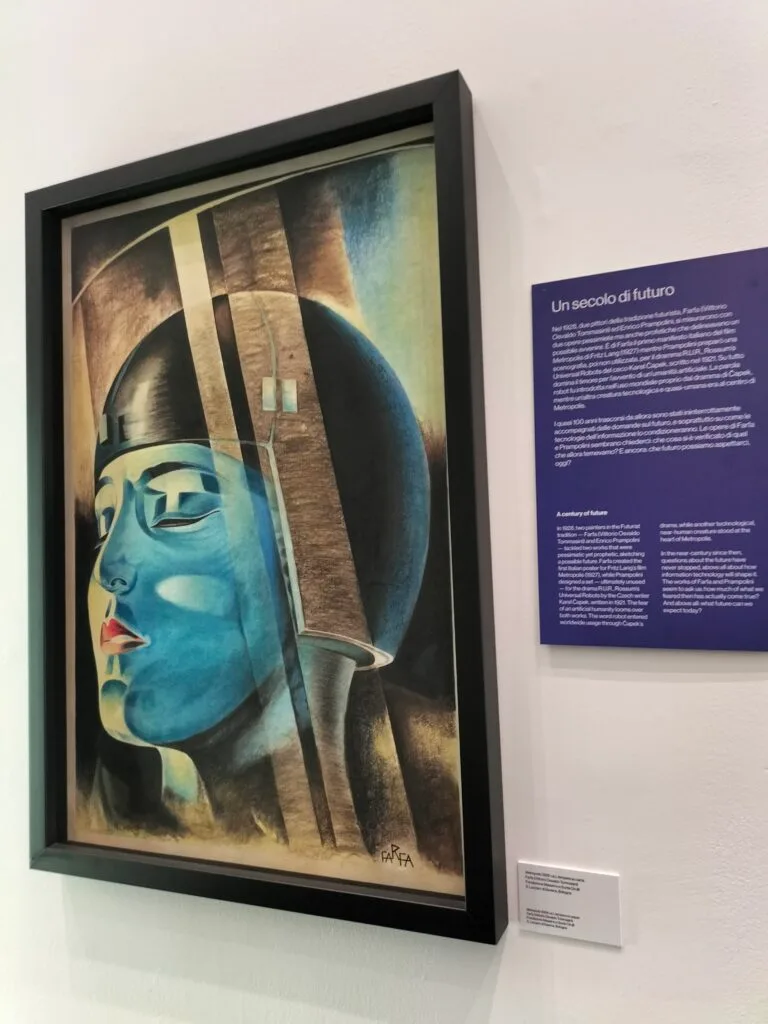
Italian poster for Metropolis (1927), created by Farfa in 1928. Tempera on paper. Fondazione Massimo e Sonia Cirulli, San Lazzaro di Savena, Bologna. Exhibition view at Triennale Milano. Photo by the author.
Lang constructs a modernity divided into two irreconcilable levels. On the one hand stands the rational world of the ruling elite; on the other, the collective body of the workers, reduced to little more than living components within a vast mechanism. This is not merely social critique, but a near-prophetic vision of technology as an autonomous system, capable of depriving human beings of control over their own destiny. And yet, at the heart of the film, a utopian tension persists: the figure of the “mediator” between heart and machine suggests a fragile but essential hope for reconciliation.
In the still-electric atmosphere of the avant-garde, Italian Futurism, particularly in its later phase, developed a very different—almost opposing—vision of modernity. In the work of Farfa, language is fragmented and accelerated: it becomes rhythm, sound, and visual fragment. The machine is not primarily perceived as a threat, but as an aesthetic principle—an expansive force capable of dissolving traditional forms of perception.
It is precisely in the contrast between Lang and Farfa that a decisive rupture emerges. If the world of Metropolis is marked by a sense of impending catastrophe—modernity understood as a system producing structural inequality—Futurism, even in its later manifestations, still tends to transform industrialisation into a positive myth: acceleration, enthusiasm, and the exaltation of the machine as form. These are two opposing responses to the same question: what is becoming of the human being within the technical system?
This tension does not belong solely to the past. In today’s world of artificial intelligence, automation, and algorithmic economies, the imagery of Metropolis returns with unsettling clarity. “Machines” are no longer simply factories, but distributed cognitive systems: networks that generate decisions, filter information, and shape behaviour. Industrialisation has not ended; it has merely transformed, becoming less visible but no less pervasive.
As in Lang’s city, we also see today an often invisible hierarchy between those who design systems and those who are subjected to them, between those who write the rules of code and those who live within its consequences. Inequalities do not disappear; they become more refined—harder to perceive, yet more pervasive. Even warfare, increasingly technological and automated, appears to extend this systemic logic to its extreme.
The dialogue between Metropolis and Farfa is therefore not simply historical, but an open question: is modernity a form of emancipation, or a mechanism of control? And above all, nearly a century later, are we still capable of imagining a future that is not merely an amplification of the present?
Perhaps the answer is not fixed. The future, after all, is never only a consequence; it is also a choice. It changes when the way we imagine it changes. It is not a predetermined trajectory, but a field of possibilities continually reshaped through slow, concrete transformations. Even small everyday shifts show that the direction of modernity is never fully written, but remains open to intervention, revision, and the possibility of being rethought.
Author: Emanuele Mulas (MSc, MIEI)
Copyright: Wittystore

